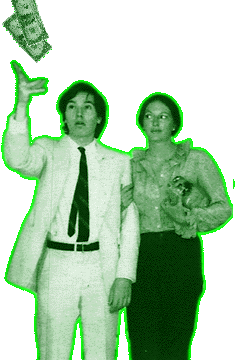
THE SMART MONEY
An Academic Approach

by Claude Argent-Monnaie (a/k/a Mark Segall)
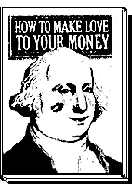
excerpted from How to Make Love to Your Money
© 1982 by Mark Segall and Margaret Tobin.
Many narrative works, both classic and obscure, are not the conventional love stories they seem, but thinly veiled tales of "that which surpasses the love of men or women" -- the love of money. The analysis of art and literature for hidden financial symbolism is called fiduciotics. Professor Claude Argent-Monnaie virtually invented the science of fiduciotics with his seminal essay The Role of Spare Change in Literature, which traced the literature of money-love from the sunny innocence of Jason and the Golden Fleece to the dark, brooding post-modernism of By Cash Possessed, from the classic Indian text the Kash-a-Sutra to the present- day Joy of Cash. Monnaie's theories are also the basis of the new monetarist school of film criticism. The essay we have chosen is a brief explanation of fiduciotic theory and methodology from Argent-Monnaie's self-acclaimed masterpiece Myth/Cliche/ Certified Check, as yet unpublished due to lack of funds.
Traditional criticism has always wrongheadedly approached narrative as "story" rather than structure. In order to apprehend the narrative "house," one must first analyze the "bricks" it is made from -- and the structural "cement" which holds them together. On the linguistic level these units are wordomatic--the paragraphomat, the sentensorama, and the wordeme. On the metalinguistic level, however, these units are monetary. Such expressions as "stop sticking your two cents in" or "stop nickel-and-diming me" are not merely idiomatic, they are central to the psychology of language (at least to the psychology of mine). Literary passages can be broken down into basic fiduciotic units (the ten-dollar word, the five-dollar word, the penny-for-your-thoughts) and further analyzed for their precious metal content. Here is a typical breakdown of a passage from By Cash Possessed:

Katrinka's hair fell down on the velvety-smooth skin ofvelvet: $40/yd
her back like a golden shower.gold: $350/oz.
Her diamond eyes sparkled.diamonds: $20,000/karat
"My treasure,"treasure: estimate unavailable
Ivan Silverubelovichsilver: $6.50/oz.
ruble: 64% on the dollar
murmured, drawing back the satin sheetssatin: $5.50/yd
"You are worth more to me than all the tea in China,oolong tea: $2.20/lb. (warehouse)
all the masterpieces in the Louvre,$1,000,000,000,000,000
all the stars in the sky."estimate unavailable
Playfully she grabbed his silver zippersilver: $6.60 oz.

The microeconomic approach yields a vast reward of literary insights. First we see that there is little 'hard" money in this passage. Such overt economic eroticism would not yet be acceptable (or redeemable) in a nineteenth-century novel. However, this passage is suffused with soft-currency symbolism, both lyrical and lucrative. Like some baroque bank statement, the book's luxurious prose only reveals its full worth if one invest the time necessary to draw it out. "One must strip away the penny-ante aspects of the work..to mine the riches within."(1) It has long been know that some works reward the reader more than others, which could easily be taken out of circulation. Presses employed to churn out such paltry works as Poor Relations and The Hunger Artist and playscripts such as Curse of the Starving Class could be better employed to print bank notes, leases, and book contracts for brilliant but unappreciated French academics.(2) The most worthwhile literature is that which can be analyzed not only word by word but also paragraph by paragraph and chapter by chapter, revealing larger fiduciotic themes. When shopping for true literary value, one must be sure the whole is greater than the sum of its parts.

Like most reputable critics, I favor a tale that involves "a fortune hunter, a fortune, a scantily clad female, and people beating each other up."(3) However, I will settle for any story in which the main character has a hoard of cash, such as A Christmas Carol.

A Christmas Carol is one of the most misunderstood works of modern literature. Traditional critics treat it as a warmhearted fable rather than a tragic tale of decline and fall. A closer reading of the work reveals a story not of moral uplift but of a forthright, honest, money-loving man buckling under to social pressure. Who has not dreamed of emulating Scrooge and casting off the petty constraints of morality and human decency, of giving his soul over to the voluptuousness of greed? Scrooge is consumed with the compulsion to count over and over each saucy sovereign, and for this he is condemned as a miser and a skinflint. What makes Scrooge heroic? He acts on his avarice, unlike the hypocrites who denounce him, who have merely repressed their illicit economic urges. He is an advanced thinker, not a credulous worshipper of "the Christmas Spirit" or the fearsome deity "Santa Claus," who "knows if you've been naughty or nice."(4) He denounces such primitive superstition as exactly what it is--"Humbug!"

What strikes the reader is Scrooge's modernity. Certainly the modern spirit of Christmas owes more to Scrooge's canny commercialism than to Cratchit's treacly sentimentality. Carol chronicles Scrooge's failure to transcend Victorian prudery and "love only gold" as a true Nietzschean Goldenmensch, or as Ian Fleming calls him, Goldfinger

Fleming's book better fits my requirements for a modern novel. It has not one but several well-endowed but barely dressed women. One is even painted completely gold to heighten the forbidden fiducioerotic thrill the hero feels when he unites with her. It is like possessing gold, like "marrying money." Goldfinger himself approaches the ideal of the heroic hoarder. Just as Scrooge is a repressed Goldfinger, Goldfinger is a fully-realized Scrooge- figure.(5) As he tells his nemesis, that formidable symbol of financial prudence, James "Bond":

"All my life I have been in love... with gold. I love its color, its brilliance, its divine heaviness..[its] soft sliminess. I love the warm tang it exudes when I melt it down into a true golden syrup. But above all, I love the power that gold alone gives its owner."

Who could be closer to his money than Goldfinger, who "carries a belt full of gold coins around his stomach" and "thin [gold] sheets in the bottom and sides of his suitcases"? Goldfinger's heroic lust cannot be contained by the narrow conventions of commerce, by timid men who think "the safest way to double your money is to fold it twice and put it in your pocket." He must do what no man has ever done--make love to all the gold in Fort Knox. Because the prudish powers-that-be find his fiscal fascination repellent, he is forced into a life of crime to gain the object of his affections. Condemned for his transgressions against the Treasury, he is hunted down and liquidated by Bond, a paid lackey of the public sector.

Goldfinger's unhappy fate is not shared by the contentious college- town couples in Edward Allsaver's Who's Afraid of Bernard Baruch? Allsaver's plot, based on a true story in Barrons, is as eternal as the theater itself: a brutal evening of capital-intensive games (Devalue the Dinner Guests, Destabilize the Department Head, and Penalize the Professor) undermines fidelity and trust and results in illegal combinations, with near-tragic consequences. Just as things look bleakest, with both partnerships tottering on the brink of bankruptcy, the characters re-evaluate their positions, withdraw their illicit tender offers, renegotiate their mutual bonds, stop competing and incorporate. George and Martha finally achieve the parenthood they have longed for--as a corporation. The younger couple starts over again on a sound basis. This happy ending is a breakthrough in the portraying of fiduciosexuality. While the taboo against showing people loving money onstage had long since been broken, amorous acquisitiveness had previously been portrayed as a liability rather than an asset.

The cinema's treatment of similar subject matter has been characteristically lighter, prime examples being George Lukor's Philadelphia Mutual Story and his musicals High Finance and Seven Bribes for Seven Brothers. Seven Bribes, featuring a famous score by Countem and Greenback and a complete backlot recreation of both public and private sectors, may be the most lavishly financed musical of all time.(6)

Fiduciosexuality in music surfaced during the Great Depression, with blues such as Buddy, Can You Spare a Dime? and more fiscally stimulating songs like We're In The Money. But it was the savage rhythm of rock'n'roll that unleashed a pent-up flood of liquidity in America and abroad. After a sneering, leering Elvis Presley begged his bank account, "Love me tender," the world would never be the same.(7)

In the academic world, fiducioticians have received no credit for their discoveries, let alone accreditation. Years after the Fiduciosexual Revolution swept college campuses, a cruel double standard still exists: it is all right to love your money, and even to live with it, but only if you keep it "under the mattress". Those who "do it" aren't supposed to talk about it, and those who talk about it lose their tenure as well as their tender.(8)

Booksellers, librarians, and my own publisher have proved even less enlightened. They have forced me to buy back (at cost) every copy of my last book, The Significance of the Insignificant in Everyday Life. This classic text is not available in any store. How much would expect to pay for such an intellectual masterwork? But wait, don't answer yet! For, if you write now, I will include at no extra cost The Book Contract as Literature: A Closer Reading. But that is not all! For a limited time only, I will also send the mystical masterpiece Secrets of the Econometricians. These secrets are known by few and understood by none. Master them and your life will be changed. Just send $9.95 to L'Ecole Fiduciotique, Box 500, Paris, France. Or, you can dial 1-800-M-O-N-N-A-I-E (in New Jersey, MOney Hill 7-1000) and charge it.
With your help my research can continue until the ideas I have expressed here become common intellectual currency. For my arguments are as sound as a dollar! No matter what cultural information I appraise and decode, it always adds up to the same thing--"la monnaie, c'est tout!"

FOOTNOTES

  1. Lionel Shilling, Mining for Meaning in Modern Literature, p. 999, Pretentious Press, $19.95 plus tax. Shilling, who was paid by the paragraph, once wrote a hundred-page essay on the word the.

  2. See my essay Pedants, Publishing's Persecuted Minority, in the July 1980 issue of Academic Angst magazine. Incidentally, I have not yet received a sou from the editors for this piece. "La checque, c'est a la poste," indeed.
  1. See Albert Moocow, Tough Guys Fight Dirty, printed in its entirety in my collection Idiotexte, Vanity Press, 1976. A tightfisted publisher and rampant academic philistinism have kept my anthology from becoming a standard college text--have conspired, in fact, to keep it out of print and off university bookshelves forever. However, a laundered version of Moocow's essay is excerpted in Susan Maytag's Against Agitation, Washday Press, 1977.

  2. Santa Claus is Coming to Town, music by J. Fred Coots, words by Haven Gillespie. Copyright 1934, Leo Feist, Inc.

  3. Other Scrooge figures include King Midas, Rumpelstiltskin, Charles Foster Kane, Long John Silver, King Tut, and fugitive financier Robert Vesco. See The Treasure in the Text: The Scrooge Figure in Fact and Fiction and Savings, Sacrifice and Redemption in the Eighteenth Century Novel, by Simon Simoleon, published by Tightwad Press.

  4. The fascinating inside story of this Mucho-Golden-Moola production is told in Raymond Ducat's exhaustingly researched Dollar Signs and Symbols in the Cinema.

  5. See Georgia Gildersleeve's great treatise on bioeconomics, Wealth and Puberty.

  6. Once, in anger, I asked the president of a great university, "Is it, then, that all money is dirty?" He smiled wanly and replied,"Of course--if it's any good!"

Return to the fabulous Mark Segall FAQ

Return to Mark's Resume

Return to The M&M Segall Home Page